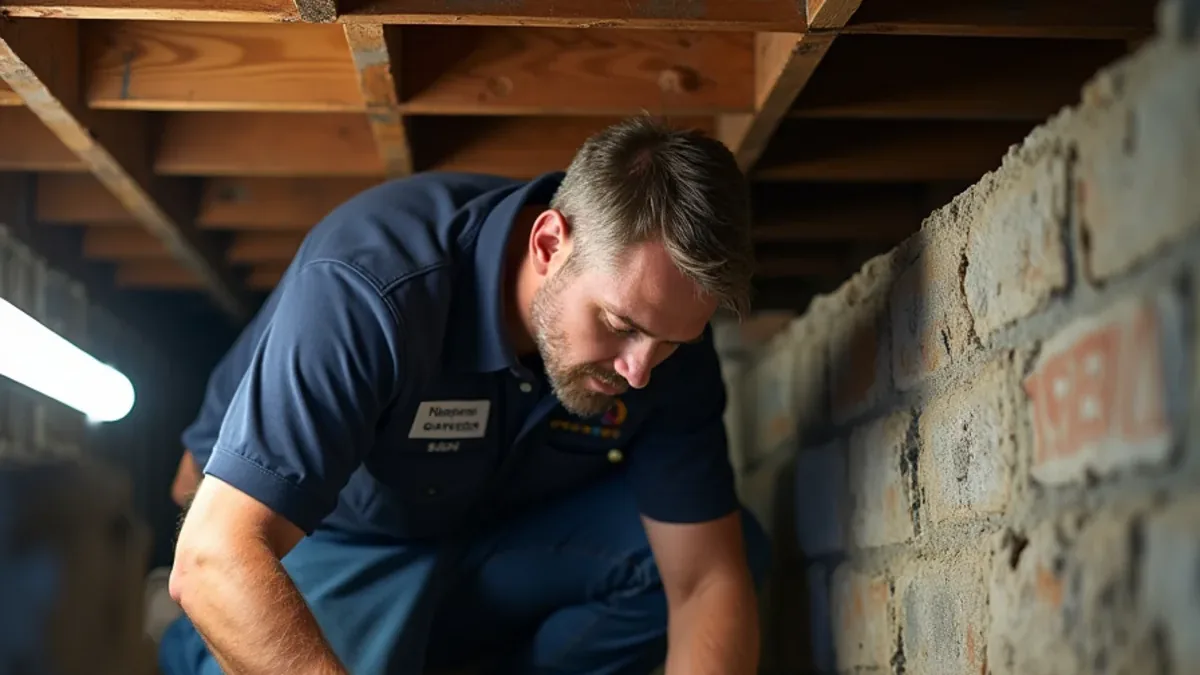

If you have moved out to Apison, Birchwood, Georgetown, McDonald, or anywhere across rural Bradley, Meigs, or Rhea County, you have probably discovered that the utility bill is refreshingly short. No water charge, no sewer charge.
What comes with that is a set of responsibilities nobody hands you a manual for. You are the water utility and the wastewater authority for your property. Here is the practical version.
Your water system
What you actually own
The well casing, the pump (usually a submersible, hundreds of feet down), the drop pipe and wire, the pressure tank, the pressure switch, and the wiring and controls. All of it. When any part fails, there is no utility to call.
The pressure tank is the part to understand
A pressure tank is not storage — it is a cushion. Inside is a bladder separating water from compressed air, and that air is what pushes water to your fixtures between pump cycles.
When the bladder fails, the tank fills entirely with water and the pump starts and stops every few seconds during any water use. That short-cycling is what actually destroys pumps, because starting is when a motor takes its most wear.
Check the air charge annually at the schrader valve on top of the tank. With the system drained, it should read a couple of psi below the pressure switch cut-in. If water comes out of the valve, the bladder has failed. Replacing a tank costs a fraction of replacing a pump it destroyed.
Test the water
Nobody does this for you. Test annually for bacteria and nitrates at minimum, and immediately after any flooding, any work on the well, or any change in taste, smell, or clarity.
Common findings in this region are hardness, iron, manganese, and hydrogen sulfide — the rotten-egg smell. Iron and manganese stain fixtures and laundry. Iron will also foul softener resin if it is not removed first, which is why the order of equipment in a treatment train matters. Details on our water softener and filtration page.
Your septic system
Know where it is
A surprising number of rural homeowners have no idea where their tank is. Find out, and get it documented — position, depth, size, and a measurement from a fixed reference point.
If you have no records, we locate and document it on the first visit. Consider installing risers at the same time; on a rural property where every service visit involves a drive, avoiding a dig each time pays back quickly.
Pump on a measured interval
Three to five years is the starting point, but the right number comes from measurement. We record sludge and scum depths every visit and set the interval from your actual accumulation rate. Full reasoning in our guide on how often to pump a septic tank in Tennessee.
Watch what goes down
Wipes, grease, and chemicals are the three that cause most rural service calls. The full list is in 10 things you should never flush on a septic system.
Where the two systems meet
Tennessee sets minimum separation distances between wells and septic components, and they exist to keep effluent out of drinking water. On older rural properties those distances have frequently been compromised — a field extended, an outbuilding added, a replacement well drilled in a convenient spot.
If you are buying rural property, verify this alongside the septic inspection. Ask where the well is, where the tank and field are, and whether the separation meets current requirements. It affects water safety and it affects what you can do with the property later.
If you already own, the practical protection is the annual bacterial test. It is inexpensive and it is the one that actually matters.
Rural plumbing beyond the house
Acreage properties have plumbing suburban ones do not: buried lines to barns and shops, frost-free hydrants in pastures, livestock waterers, and pressure systems feeding multiple buildings.
The failure worth knowing about is a leak in a buried line. It produces no visible wet spot — the water disappears into the ground — and the only symptom is a well pump running more than it should. If your pump seems busier than it used to be, that is worth investigating before it becomes a pump replacement.
A yearly checklist
- 1Test the well for bacteria and nitrates
- 2Check the pressure tank air charge against the switch cut-in
- 3Clean the septic effluent filter if your tank has one
- 4Do a food-coloring test on every toilet — a silent runner overloads a drain field fast
- 5Walk the drain field looking for soft ground, standing water, or unusual grass growth
- 6Check that downspouts and surface runoff drain away from the field, not across it
- 7Confirm your pumping interval is still right for your household size
That is an hour a year and it prevents most of the calls we take.
We work rural Hamilton, Bradley, Meigs, Rhea, Sequatchie, and Marion County — Birchwood, Decatur, Georgetown, Sale Creek and beyond. If you would rather have somebody else track the schedule, that is what our septic maintenance plans are for.
Frequently asked
Annually for bacteria and nitrates at minimum, plus immediately after any flooding, any work on the well, or any change in taste, smell, or clarity. If there is a septic system on your property or a neighboring one — which out here there almost always is — that annual test is genuinely worth doing rather than skipping.
The most common causes are a leak somewhere in the system and a failing pressure tank. On acreage, a leak in a buried line to a barn or outbuilding is a frequent culprit and it produces no visible wet spot — the water simply disappears into the ground. It is worth diagnosing before it turns into a pump replacement.
Tennessee sets minimum separation distances, and they exist to protect drinking water. On older rural properties those distances have often been compromised by later additions or a replacement well drilled somewhere convenient. Verify it before you buy, and test annually if you already own.
Need someone to actually look at it?
We are a licensed plumber and septic technician based in Ooltewah, serving Hamilton, Bradley and the surrounding counties. Free estimates on every job, and an honest answer about whether you need the work at all.