Hard water is water carrying dissolved calcium and magnesium. It is not a health issue and it is not a contaminant. What it is, is expensive — slowly, in small amounts, across every water-using thing you own.
It is also the most common water complaint across the Chattanooga area, and the one homeowners live with longest before doing anything about it.
What you can see
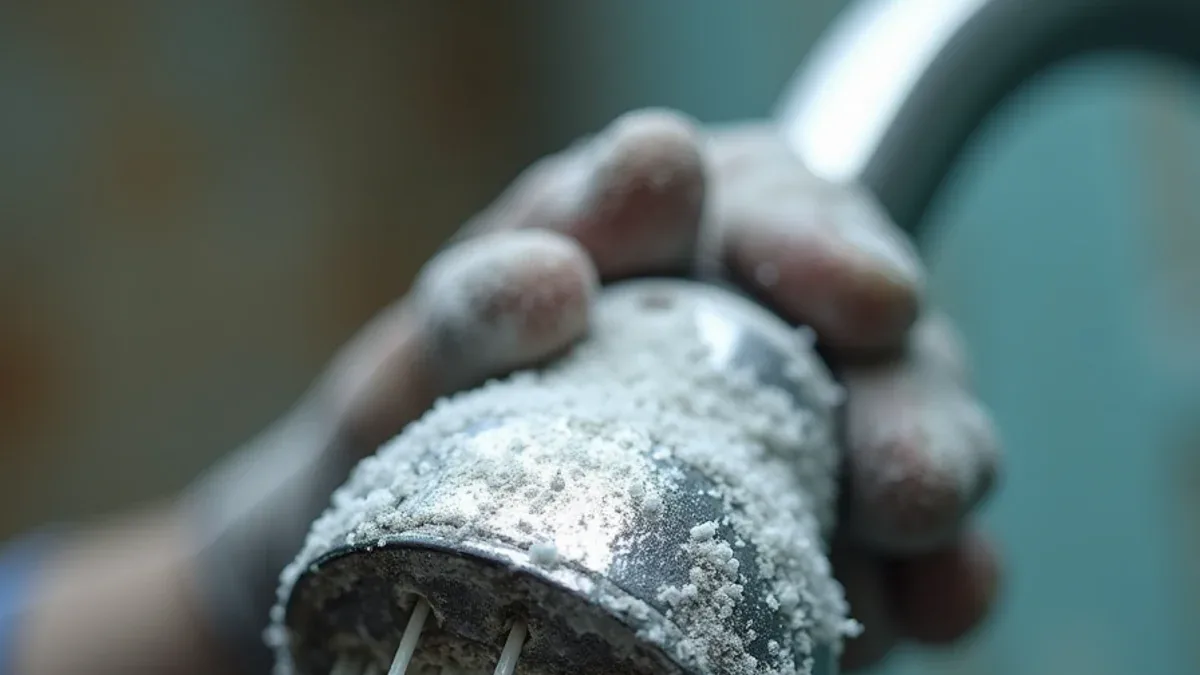
- White crust on faucets, showerheads, and around drains
- Spots on glassware that no amount of rinse aid removes
- A film on shower doors that comes back within days of cleaning
- Soap and shampoo that will not lather properly
- Laundry that feels stiff and colors that fade faster
- Dry skin and hair after showering
Those are the annoyances. They are not the expensive part.
What you cannot see
Your water heater
This is the biggest single cost. When water is heated, dissolved minerals precipitate out and settle to the bottom of the tank.
In a gas heater the burner is underneath, so that sediment layer insulates the flame from the water. The burner runs longer, the tank bottom overheats, and the steel fatigues. In an electric heater the lower element ends up buried in sediment and burns out early.
The practical result is a heater rated for twelve years that fails at seven or eight. Our article on water heater repair versus replacement goes deeper on how to tell where yours stands.
Your fixtures
Cartridges and valve seats wear faster in mineral-laden water. Faucets that should give fifteen years start dripping at seven. Aerators and showerheads clog, reducing flow to a trickle — which people usually blame on water pressure.
Your appliances
Dishwashers and washing machines have heating elements and valves that scale the same way. Manufacturers rate appliance life assuming reasonable water; hard water shortens it.
Your pipes
Scale builds inside pipe over decades, particularly in older galvanized and copper systems. It is slower than the effect on a water heater but it is cumulative, and it contributes to the gradual pressure decline people notice in older homes.
The free maintenance nobody does
Before spending anything on equipment, do these three things in one afternoon.
- 1Unscrew every faucet aerator and soak it in vinegar overnight. The flow improvement is often dramatic.
- 2Do the same with every showerhead, or bag vinegar around it and leave it a few hours.
- 3Flush your water heater. Twenty minutes, removes loose sediment before it hardens.
That costs nothing and it noticeably improves the house. It also tells you how much of your "low water pressure" was actually scale.
Where the scale actually lands
| Where it collects | What you notice | What it costs you |
|---|---|---|
| Water heater tank | Rumbling or popping while it heats | Sediment insulates the burner from the water, so it runs longer and fails years early |
| Tankless heat exchanger | Falling flow, then error codes | A narrowed exchanger, and a warranty claim that gets denied without descaling records |
| Aerators and showerheads | A spray that has gone weak or sideways | Nothing, if you soak them in vinegar twice a year — people replace fixtures that only needed cleaning |
| Dishwasher and washing machine | Film on glassware, laundry that feels stiff | More detergent for the same result, and shorter appliance life |
| Fixtures and glass | White crust and spotting that returns immediately | Finish damage on taps and shower doors that does not polish out |
Reading down that list is how you decide whether you need treatment or maintenance. If it is only the last two rows, a routine and a bottle of vinegar handle it. If the heater is already rumbling, the scale is somewhere you cannot reach with a cloth.
Should you install a softener?
Start with a test. Hardness varies by source and by whether you are on municipal water or a private well, and the only number that matters is the one at your own tap. We test free.
If the number is high, a whole-home softener protects the water heater, fixtures, and appliances all at once. It is one of the few home upgrades where the payback is genuinely calculable — count the water heaters and faucets you will not replace early.
Salt-based or salt-free?
A salt-based ion exchange softener actually removes hardness minerals, exchanging them for sodium on a resin bed. Your water is genuinely soft.
A salt-free conditioner crystallizes the minerals so they are less likely to stick to surfaces — the hardness is still in the water. It needs no salt, no drain, and no electricity, which suits some households, but on very hard water it does less.
Full comparison on our water softener and filtration page.
If you are on a well
Test for iron and manganese as well as hardness. Iron will foul softener resin if it is not removed first, which is why the order of equipment in a treatment train matters and why buying a softener off a shelf without testing frequently ends badly.
More on well water in our guide to well water and septic living in rural southeast Tennessee.
One note for septic properties
A correctly sized, demand-initiated softener discharging normally is not a problem for a healthy septic system. What causes trouble is an oversized or badly programmed unit regenerating far more often than needed, sending unnecessary volume into the tank.
If your home is on septic, say so when you get a quote — it affects how the system should be sized and programmed. We test water and install treatment across Ooltewah, Harrison, Apison and the surrounding area, and the test is free.
Frequently asked
It varies by source and by whether you are on municipal water or a private well, so the only number that matters is the one from your own tap — and we test it free. What is well established is that hard water is a widespread issue across the Chattanooga area, and it is a large part of why water heaters here often fail before their rated life.
No. Ion exchange adds a small amount of sodium proportional to the hardness removed, well below the taste threshold at normal hardness levels. If you are on a sodium-restricted diet, a potassium chloride softener is a direct substitute, and a reverse osmosis unit at the kitchen tap removes it entirely.
They do different things. A salt-based softener removes hardness minerals through ion exchange, so the water is genuinely soft. A conditioner crystallizes the minerals so they stick less — the hardness remains. Conditioners need no salt or drain and are lower maintenance, but on very hard water a salt-based system does considerably more.
Need someone to actually look at it?
We are a licensed plumber and septic technician based in Ooltewah, serving Hamilton, Bradley and the surrounding counties. Free estimates on every job, and an honest answer about whether you need the work at all.