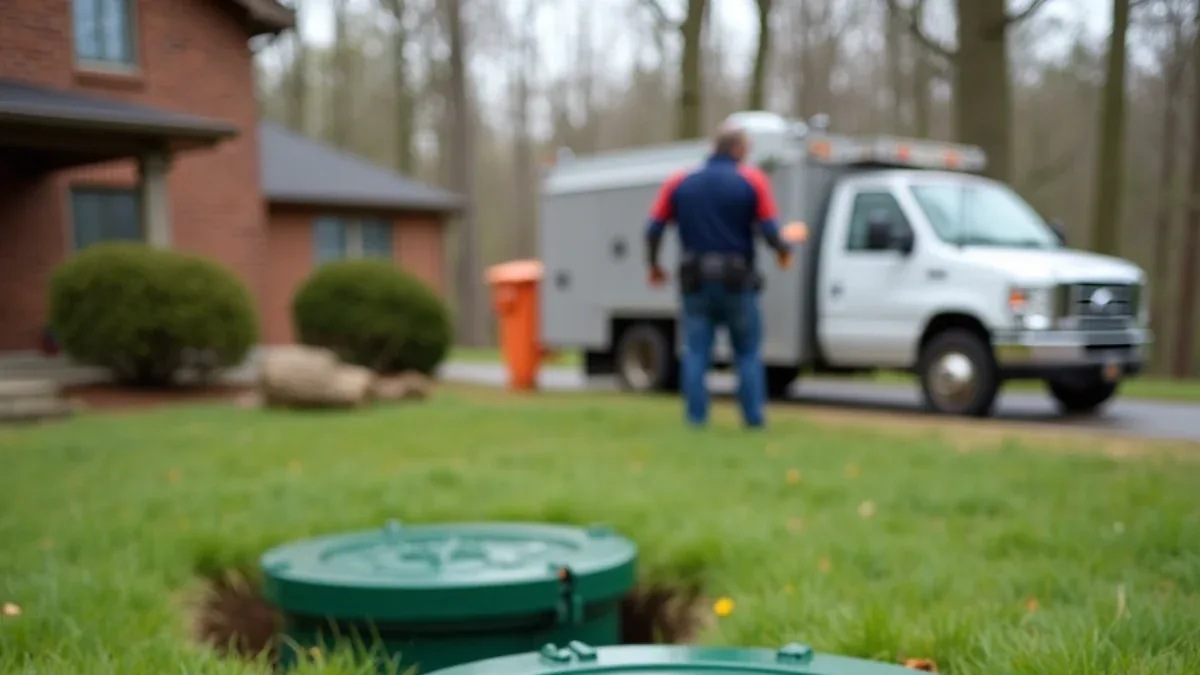
The drain field is where the real treatment happens. Effluent leaves the tank, spreads through a network of trenches, and the soil finishes the job biologically. It is also the single most expensive component of a septic system to replace, which is exactly why it deserves a careful diagnosis rather than an assumption.
A good share of the fields we are called to replace do not need replacing. They need a distribution box releveled, a tank sealed, or a leak fixed inside the house.
How a drain field actually fails
A biomat forms at the bottom of every trench. It is a dense biological layer, and it is not a defect — it is part of how the soil treats effluent as it passes through. Failure happens when that layer thickens faster than the soil can process, and the trench bottom effectively seals.
Four things accelerate that.
Solids from an unpumped tank
This is the leading cause, by a wide margin. When the tank is full, solids leave with the effluent and reach the trenches, where the soil cannot process them. They accumulate in the biomat and seal the trench faster than anything else will.
Hydraulic overload
Too much water, too fast. A running toilet, a dripping fixture, a water softener regenerating far more often than it needs to, groundwater entering a cracked tank, or six loads of laundry in one morning. The field never gets the rest period it needs to process what it has already received.
Compaction
Parking on the field, driving equipment across it, or building a shed on top of it compresses the soil and destroys its structure. Soil that has been compacted cannot accept water the way it did, and there is no practical way to undo it.
Grease and chemicals
Kitchen grease coats soil particles and reduces infiltration. Heavy bleach, drain chemicals, and solvents kill the bacterial population the system depends on. Neither is dramatic on any single day; both are cumulative.
The warning signs, from earliest to worst
- Grass over one trench is greener and grows faster than the rest of the yard
- The ground over the field feels soft or spongy underfoot in dry weather
- Sewage odor outdoors, particularly after rain
- Drains slow down within days or weeks of a pump-out
- Standing water or visible effluent surfacing over the trenches
- Backups into the house that pumping only relieves briefly
The problems that look like field failure but are not
A failed distribution box
The D-box is a small concrete box that splits flow evenly between trenches. When it settles out of level, or its outlets corrode, one trench receives the entire household load while the others sit dry.
The symptom is a field with one saturated area and the rest normal. Releveling or replacing the box is inexpensive and it frequently restores the whole field. This is the single most commonly missed cheap fix in septic work.
Groundwater entering the tank
On sloped properties around Harrison, Soddy-Daisy, and the ridges, groundwater moving through the soil finds cracks below the tank liquid line or a failed lid seal, and fills the tank on its own.
The tell is seasonal: fine in August, backing up in February. The homeowner reasonably concludes the field has failed. Sealing the tank is a repair, not a replacement.
A leak inside the house
A silently running toilet can pass hundreds of gallons a day into a field that is already at capacity. We have opened tanks running at their limit where household water use was completely ordinary — the cause was two toilets quietly running upstairs. A food-coloring test costs nothing and takes fifteen minutes.
Root intrusion in the field lines
Roots find perforated field lines just as readily as they find sewer joints. Where the lines are otherwise sound, clearing roots can restore real years of service.
What repair actually looks like
We work through it in order of cost. Check the tank level and condition. Open and inspect the distribution box. Probe the field to map which trenches are saturated and which are dry. Camera or clear the lines where that is appropriate. Only when all of that is ruled out do we start talking about rebuilding.
When replacement genuinely is the answer, it starts with a soil evaluation of the reserve area, then a county permit, then construction. Details are on our drain field repair page.
Extending the life of a field that still works
- Pump the tank on a measured interval — this is the single highest-value habit
- Fix running toilets and dripping fixtures promptly
- Spread laundry across the week rather than doing it all in one morning
- Divert downspouts and surface runoff away from the field
- Keep vehicles, trailers, and livestock off the field entirely
- Plant grass over the field and nothing else — no shrubs, no trees, no vegetable beds
A field that is treated well routinely outlasts expectations. One that is abused fails in a decade. The difference is almost entirely habits rather than luck.
If you are seeing any of the warning signs above anywhere around Ooltewah, Cleveland, or Harrison, get a diagnosis before anyone quotes you a new field. The estimate is free and the odds that it is something cheaper than you fear are genuinely good.
Frequently asked
Twenty to thirty years is a fair expectation in this area with regular pumping and reasonable water use. Fields that are never pumped, driven over, or hydraulically overloaded fail considerably sooner. Well-maintained fields in good soil sometimes reach forty.
Sometimes, and it depends entirely on the cause. If the problem is a failed distribution box, root intrusion, or overload from a leak or a cracked tank, fixing the cause restores function. If the trench bottoms have sealed with a mature biomat, no treatment reverses that reliably — and anyone who tells you otherwise is selling something.
That usually points at the distribution box rather than the field itself. When a D-box settles out of level or its outlets corrode, effluent stops splitting evenly and one trench absorbs everything. It is inexpensive to fix and it frequently restores the entire field.
Need someone to actually look at it?
We are a licensed plumber and septic technician based in Ooltewah, serving Hamilton, Bradley and the surrounding counties. Free estimates on every job, and an honest answer about whether you need the work at all.