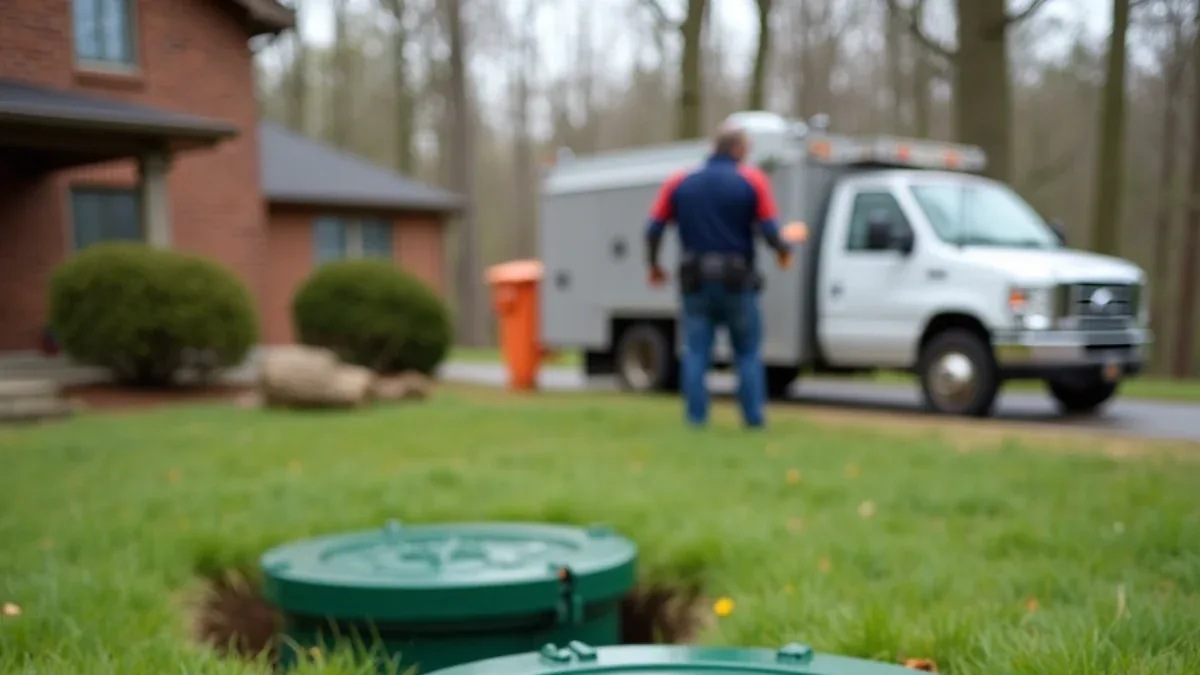
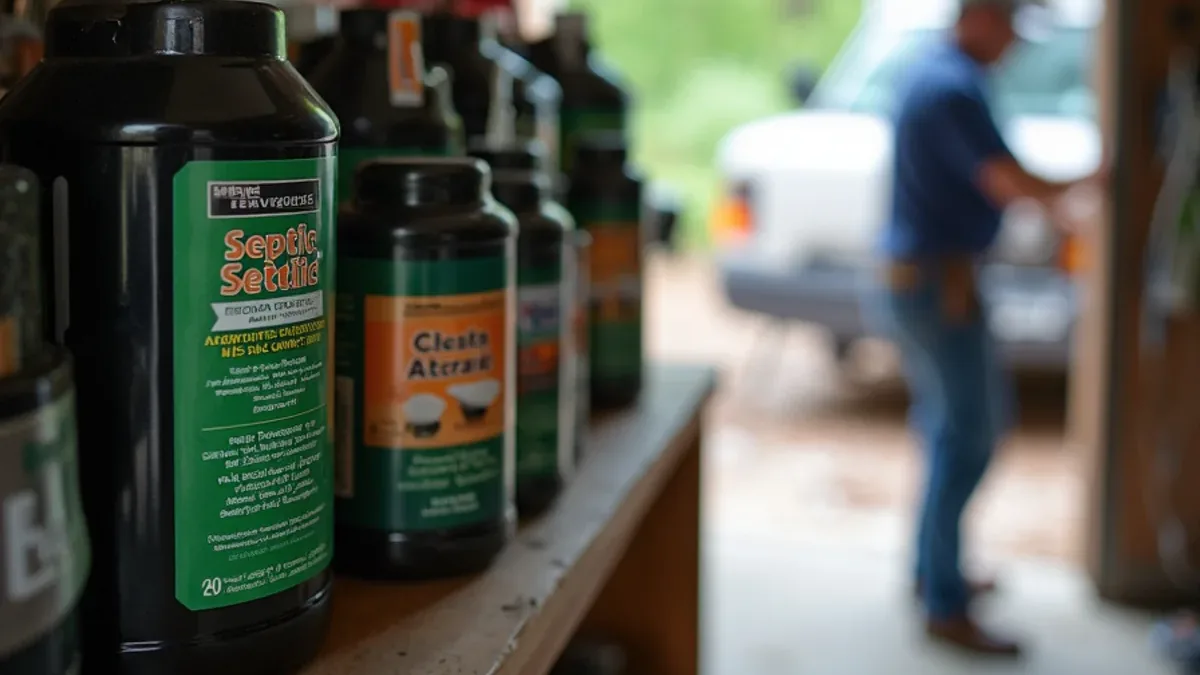
Every hardware store in Hamilton County has a shelf of septic tank additives. Monthly treatments, enzyme packets, bacterial boosters, and a few products promising to restore a failing drain field. They are inexpensive, they are marketed well, and they appeal to the entirely reasonable hope that a maintenance problem can be solved with a subscription instead of a truck.
We do not sell any of them, which makes this a straightforward article to write. Here is what the categories actually do.
The claim behind additives
A septic tank works biologically. Bacteria break down organic solids, reducing the volume that accumulates as sludge. The additive pitch follows from that: add more bacteria or enzymes, break down more material, need pumping less often.
The logic is sound as far as it goes. The problem is what it leaves out.
Why it does not follow
A healthy tank is not short of bacteria
A septic tank receiving normal household waste is continuously seeded with bacteria — the material arriving brings its own. Under ordinary conditions the tank is not bacteria-limited. Adding more does not accelerate a process that is not being held back by a shortage.
The exception is a tank where the population has been genuinely suppressed, usually by heavy chemical use. In that specific case, reducing the chemicals matters far more than adding a product, and the population recovers on its own within weeks.
Much of the sludge is not biodegradable
This is the point that settles it. A significant fraction of what accumulates at the bottom of a septic tank is inorganic — mineral matter, grit, plastic fibers from laundry, and the residue of everything that was never going to break down.
No bacterium or enzyme digests sand. That material accumulates regardless of what you add, and the only way it leaves the tank is on a pump truck.
The products, category by category
Biological additives (bacteria and enzymes)
The most common and the least harmful. In a healthy system they are largely redundant. In a system recovering from heavy chemical use they may do something marginal. They will not eliminate the need for pumping, and no reputable product claims they will — read the fine print and you will usually find a line recommending regular pumping anyway.
Yeast
The old home remedy of flushing a packet of baker's yeast. It is harmless and it is not doing much. Yeast is a fungus adapted to sugars, not to the mixed organic load in a septic tank, and it does not establish a lasting population there.
Chemical and solvent additives
This is where actual harm happens. Some products use surfactants or solvents to break up the scum and sludge layers. That sounds useful and it is the opposite of useful.
Breaking up the layers means the solids no longer stay where they belong. Instead of settling out, they move with the effluent through the outlet and into the drain field — precisely the failure mode that a septic tank exists to prevent. Some of these products are restricted in various jurisdictions for exactly this reason.
Drain field "restorers"
Products promising to rejuvenate a failing field. If the field is failing because of a distribution box, root intrusion, or hydraulic overload, fixing the actual cause restores it and no product was involved. If the trench bottoms have sealed with a mature biomat, nothing poured down a toilet reverses that.
What actually extends a septic system's life
- 1Pump on a measured interval — the single highest-value action available
- 2Clean the effluent filter annually if your tank has one
- 3Keep wipes, grease, and chemicals out of the system entirely
- 4Fix running toilets promptly — hydraulic overload is a leading cause of field failure
- 5Spread water use across the week instead of concentrating it
- 6Keep vehicles and structures off the drain field
- 7Divert roof and surface water away from the field
None of that is exciting and all of it works. The money a household spends on monthly additives over five years is a meaningful fraction of a pump-out, and the pump-out is the thing that actually protects the field.
The one situation where a product helps
If a system has been through a genuine bacterial kill — a large volume of bleach, a chemical spill, a course of strong antibiotics in a small household — reseeding can shorten the recovery. Even then, the population usually rebuilds on its own within a few weeks of normal use.
That is a narrow case, and it is not what the monthly-treatment marketing is aimed at.
What to do instead
Find out where you actually stand. We measure the sludge and scum layers in your tank and tell you plainly whether you need pumping now or in two years. If the answer is two years, that is what we will say.
Book a septic tank pumping and inspection anywhere across Ooltewah, Collegedale, McDonald or the wider area. Estimates are free, and if you would rather not track the interval yourself, our maintenance plans do it for you.
Frequently asked
No. A meaningful fraction of what accumulates in a tank is inorganic material that no biological product digests, and it only leaves on a pump truck. Read the fine print on most reputable additives and you will find a line recommending regular pumping regardless.
Yes — the ones using solvents or surfactants to break up the scum and sludge layers. Breaking up those layers sends solids out through the outlet into the drain field, which is exactly the failure the tank exists to prevent. Avoid anything advertising that it dissolves or emulsifies sludge.
It is harmless and it does very little. Yeast is adapted to sugars rather than the mixed organic load in a tank, and it does not establish a lasting population. A tank receiving normal household waste is already continuously seeded with the bacteria it needs.
Need someone to actually look at it?
We are a licensed plumber and septic technician based in Ooltewah, serving Hamilton, Bradley and the surrounding counties. Free estimates on every job, and an honest answer about whether you need the work at all.