Homes around Ooltewah and Collegedale have been moving fast, and in a market like that buyers waive things. Most of what gets waived is survivable. The septic system is not on that list.
Here is what a real septic inspection covers, what your home inspector will and will not do, and the specific questions worth asking before your contingency expires.
What your home inspector actually does
A general home inspector will flush the toilets, run the taps, confirm the drains work, look for surface evidence of a problem, and write something close to: "Septic system present. Recommend evaluation by a qualified specialist prior to closing."
That is not a failure on their part. Septic evaluation is explicitly outside the standard scope of a home inspection, and they are being appropriately cautious. But it means the most expensive system on a rural property has not been looked at by anyone.
What a real septic inspection covers
- 1Records review — the original permit, the as-built drawing, any repair history, and critically the bedroom count the system was permitted for
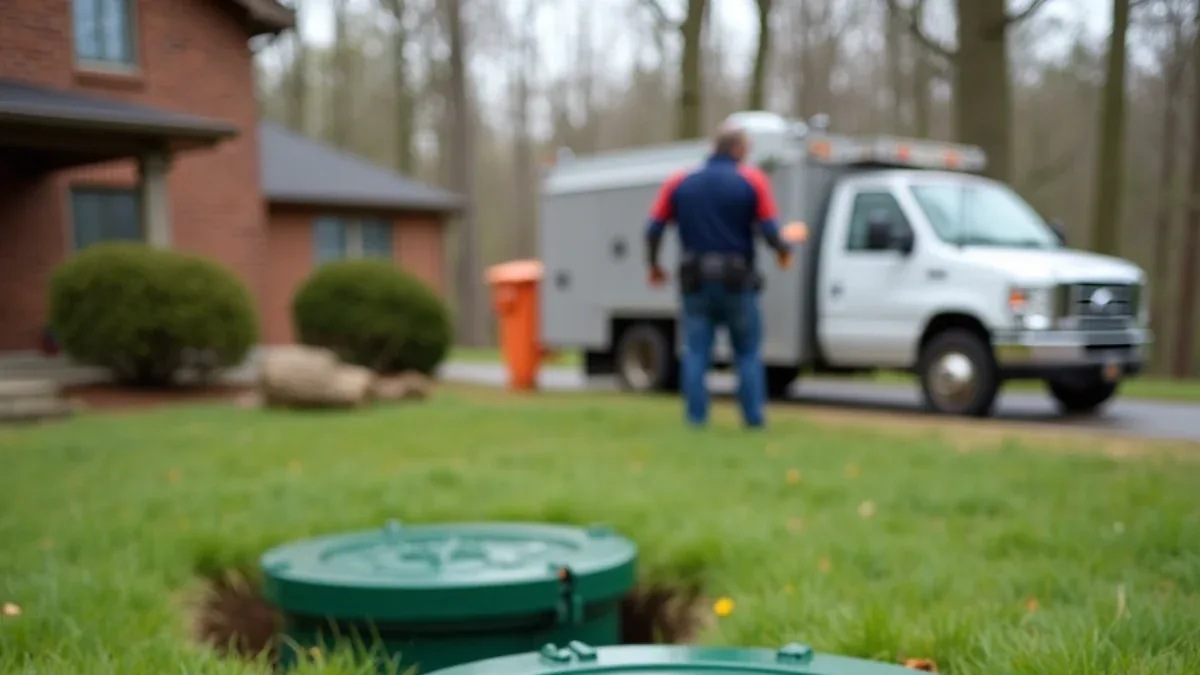
- 2Locating and opening both tank lids — an inspection where nobody opened the tank is not an inspection
- 3Measuring liquid level relative to the outlet, plus scum and sludge depths
- 4Inspecting inlet and outlet baffles, effluent filter, tank walls and floor, lids and risers
- 5Checking the distribution box and, on systems that have them, the pump, floats, and alarm
- 6Load-testing the drain field with a measured volume of water
- 7A written report with photos, findings, and cost ranges for anything recommended
Three questions to ask the seller
When was the tank last pumped, and is there a receipt?
A documented pumping history is the single best indicator that a system has been cared for. No records does not mean the system is bad — plenty of rural Tennessee sellers genuinely have none — but it does mean you are inspecting rather than assuming.
Where is the permit and the as-built drawing?
The permit tells you the tank size, the field design, and how many bedrooms the system was approved for. That last number matters enormously.
If a house is advertised as four bedrooms and the septic permit says three, that is a real issue. It affects financing on some loan programs, it affects what you can legally do with the property, and it means the system has probably been running over its design flow for years.
Has any part of the system been repaired or replaced?
A replaced field is good news if it was permitted and recent. An unpermitted repair is a problem you inherit. Ask specifically whether the work was permitted and inspected.
Red flags worth taking seriously
- Fresh sod or new landscaping over the drain field area right before listing
- A tank that was pumped days before your inspection with no history behind it
- A permit for fewer bedrooms than the house currently has
- A well and a septic field that appear to be closer together than current setbacks allow
- Any part of the field under a driveway, patio, shed, or parking area
- No reserve area available on the lot for a future replacement field
Do the sewer scope too
The septic inspection covers the tank and field. It does not cover the line from the house to the tank, and on older properties that line is frequently the actual problem — bellied, root-intruded, or broken.
A sewer camera inspection is inexpensive and takes under an hour. On any home built before 1980, or any property with mature trees between the house and the tank, it belongs on the list alongside the septic inspection.
What happens if the inspection finds a problem
You get the finding documented with photos and a realistic cost range, and then you have facts to negotiate with rather than fear.
Plenty of findings are minor. A missing baffle, a filter that has never been cleaned, a lid that needs replacing, risers that should be installed. Those are modest numbers and they are reasonable things to ask a seller to address or credit.
When the finding is a failing drain field, that is a different conversation, and it is exactly the conversation you want to have before closing rather than in your second winter in the house.
Timing it inside the inspection period
Book the septic inspection the day the contract is signed. Inspection periods are short, and a septic evaluation takes a couple of hours on site plus report time. If the tank needs to be pumped for a proper look at the floor and baffles, that adds scheduling.
We do these across Ooltewah, Collegedale, Cleveland, Apison, Harrison and the wider rural counties, and we can usually work around a contract deadline. Full details on our septic system inspection page, and the estimate is free.
Frequently asked
Not by state law for a conventional sale, though some lenders and loan programs require one. We recommend it regardless. The cost is trivial next to a drain field replacement, and buyers on rural Hamilton and Bradley County properties have the most to lose by skipping it.
Usually the buyer, as part of their due diligence, though it is negotiable and some sellers commission one proactively to head off objections. Either way, make sure the inspection is done by someone working for you and that you receive the full report rather than a summary.
It is a snapshot of the system on that day. Most agents and lenders treat a recent inspection — within a few months — as current. A field that load-tested well in a dry August may behave differently in a wet February, which is worth understanding when you read a report done in a dry season.
Need someone to actually look at it?
We are a licensed plumber and septic technician based in Ooltewah, serving Hamilton, Bradley and the surrounding counties. Free estimates on every job, and an honest answer about whether you need the work at all.